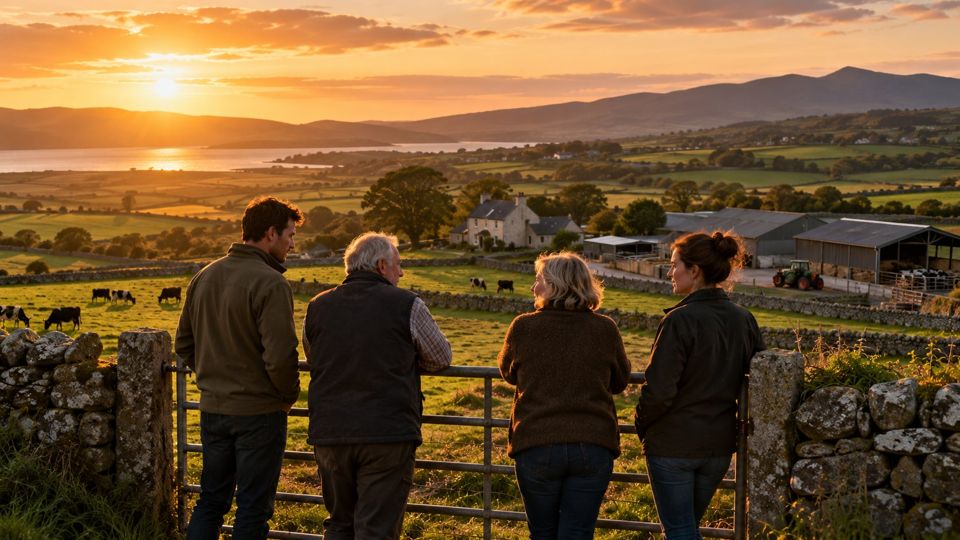
One of the most difficult questions in farm succession often has nothing to do with tax — and everything to do with what feels fair.
Ask almost any parent what worries them most about succession planning, and the answer usually is not tax.
It is not legal paperwork.
It is not Agricultural Relief.
More often than not, it is a much more personal and much more difficult question:
“How do we treat everyone fairly?”
This is one of the hardest parts of farm succession because fairness and equality are not always the same thing.
And understanding the difference can be one of the biggest challenges a farming family will face.
Every parent is trying to protect more than assets
Most parents I speak to want very similar things.
They want to protect the farm.
They want to preserve family relationships.
They want every son and daughter to feel valued.
They want to avoid resentment, conflict and lasting damage within the family.
And they want to feel, at the end of it all, that they have done the right thing.
These are all completely reasonable goals.
The difficulty is that they do not always point towards the same solution.
What protects the farm may not feel equal.
What looks equal on paper may not feel fair in practice.
And what seems fair to one person may feel very different to another.
Equality is easy to describe
Equality sounds straightforward.
Everyone gets the same.
The land is divided equally.
The value is divided equally.
On paper, that can feel like the cleanest and fairest answer.
But farm succession rarely exists only on paper.
And that is where the difficulty begins.
A farm is not just another asset
A family farm is very different from money in a bank account.
It is often:
a working business
a home
a livelihood
a long-term family asset
and something built up over generations
That means decisions about succession cannot usually be reduced to a simple question of:
“What is everything worth, and how do we divide it evenly?”
A farm has to be looked at not only for its value, but for how it actually functions.
Who is farming it?
Who hopes to farm it in the future?
Can it support multiple families?
Would dividing it weaken it?
Would trying to make everything equal create a worse outcome for everybody?
These are often the questions families do not fully confront until much later in the process.
Fairness becomes harder when every child's circumstances are different
No two children in a family are ever in exactly the same position.
One may have spent years working on the farm.
Another may have built a life and career away from it.
One may want to continue farming.
Another may have no interest in the farm at all.
One may already have received significant financial support.
Another may not have.
One may see the farm as a livelihood.
Another may see it mainly as an asset.
These differences do not automatically tell you what is fair.
But they do mean fairness is rarely something that can be worked out by formula.
Fair does not always mean identical
This is one of the most important mindset shifts in succession planning.
Treating people fairly does not always mean treating them identically.
That can be an uncomfortable idea at first, especially for parents who naturally want to avoid causing hurt.
But once a family begins looking at the reality of the farm, the people involved and the future of the business, the question often changes.
Instead of asking:
“How do we divide everything equally?”
the more useful question becomes:
“What outcome would actually be fair for everyone involved?”
Those are very different questions.
And they often lead to very different conversations.
The hardest part is that fairness is personal
Tax can be calculated.
Legal ownership can be documented.
Assets can be valued.
But fairness is more human than that.
It is shaped by:
contribution
expectation
need
sacrifice
opportunity
family history
and what each person believes was understood over the years
That is why fairness can quickly become emotionally charged.
Two members of the same family can look at the same proposed outcome and see it very differently.
That does not necessarily mean either person is wrong.
It usually means the family has reached the point where assumptions are no longer enough.
Assumptions are one of the biggest causes of difficulty
One of the reasons fairness becomes so difficult in farm succession is that families often assume they already know what everyone wants.
Parents assume.
Children assume.
Brothers and sisters assume.
But assumptions are dangerous.
Parents may assume one child expects the farm.
That child may actually be unsure they want the responsibility.
A non-farming child may appear unconcerned, while quietly carrying a very different sense of what is fair.
Another may not want assets at all, but may desperately want clarity.
Until proper conversations happen, families are often working from guesswork.
And guesswork is a poor foundation for a succession plan.
There is rarely a perfect answer
This is another important reality.
Many families approach succession as if there must be one perfect solution that keeps everybody happy, protects the farm, avoids conflict and solves every practical issue at once.
Usually, there is not.
Succession planning often involves balancing competing priorities, such as:
preserving the farm as a viable unit
supporting Mam and Dad financially
recognising the contribution of the farming child
treating non-farming children fairly
reducing future conflict
and creating a structure that can actually work
The goal is not perfection.
The goal is to arrive at a thoughtful and well-considered outcome that reflects the reality of the family and the farm.
Fairness conversations need structure
This is where many families get stuck.
They know fairness needs to be discussed.
But they do not know how to have that discussion productively.
Without structure, these conversations can quickly become vague, emotional or circular.
People talk around the issue rather than through it.
The discussion becomes about positions instead of understanding.
And families often leave the conversation feeling even less clear than when they started.
That is why these conversations often need a process.
Not because someone outside the family should decide what is fair.
But because many families need help creating enough clarity to talk about the issue properly.
A question worth asking
One of the most useful questions a family can ask is:
“What does a fair outcome look like to you?”
Not equal.
Fair.
That one shift in language can change the conversation completely.
It allows each person to explain what they are actually thinking, rather than forcing everything into a simple equal-versus-unequal frame.
The answers are often very revealing.
And they often become the starting point for the conversations that matter most.
Why this matters so much in succession planning
A family can solve tax.
A family can update a will.
A family can transfer assets.
But if the fairness question is ignored, avoided or handled badly, the consequences can last far longer than any tax bill.
This is why fairness is not some soft, secondary issue in succession planning.
It is central.
Because succession is not just about transferring land.
It is about transferring responsibility, preserving relationships and shaping what family life looks like long after the transfer is done.
The key point
Equality is simple.
Fairness is harder.
But in farm succession, harder does not mean less important.
In fact, it usually means the opposite.
The most successful succession plans are rarely the ones that simply divide assets by value.
They are the ones that take the time to understand the farm, the family, the people involved and what a fair outcome genuinely looks like in that specific case.
Want clarity on how to approach fairness in your own family?
This is one of the most difficult parts of farm succession because there is no universal formula.
Every family is different.
Every farm is different.
And what feels fair in one situation may not work at all in another.
During a Farm Succession Planning Session, we look at the wider family picture, the concerns that are sitting beneath the surface and the key questions that need to be addressed before decisions are made.
Sometimes the biggest value is not in having an immediate answer.
It is in getting enough clarity to start the right conversation in the right way.
If you want to understand what issues need to be worked through in your own family situation:
Join the Farm Succession Planning Session Waiting List Below
Sessions are released in limited numbers.