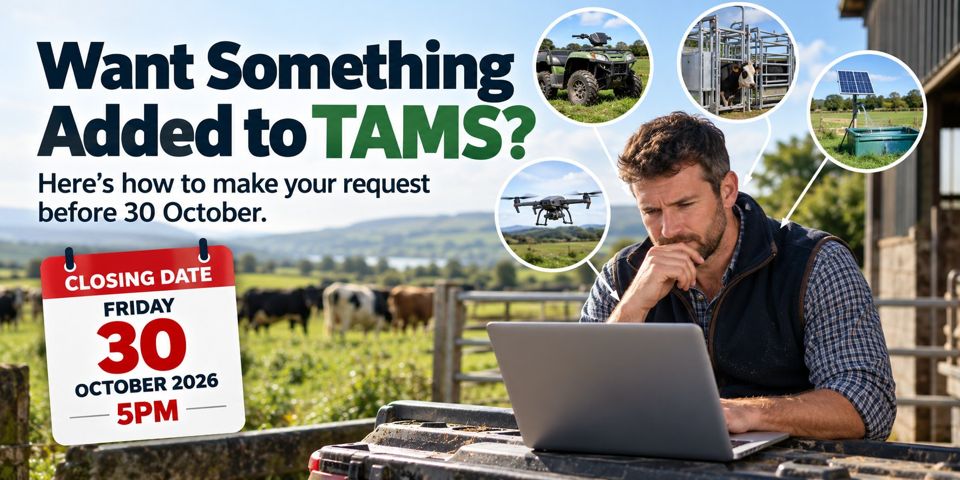
There's a piece of farming equipment you'd love to buy, but there's one problem. It isn't covered under TAMS. Well, now is your opportunity to do something about it.
The Department of Agriculture, Food and the Marine is inviting farmers to have their say on what equipment, technology and infrastructure should qualify for grant aid under TAMS.
Through its Call for Evidence, the Department is seeking proposals for new investments that could be added to the scheme, as well as feedback on investments already supported.
This isn't an application for a TAMS grant. It's an opportunity to make the case for something you believe should be eligible for TAMS funding, either under the current scheme or future farm investment supports.
And you don't need to be an agricultural consultant, an engineer or an expert in government policy to contribute.
You just need to explain what you want included, why it should be supported and how it would benefit farmers.
The closing date is Friday, 30 October 2026, at 5pm.
I've put together a submission template to make the process easier. This guide explains exactly how to complete it.
First, What Is the Department Looking For?
The Department wants evidence to help it assess which farm investments should be supported through TAMS 3 and future schemes under the Common Agricultural Policy (CAP).
That could include investments that improve:
Farm safety and animal welfare.
Labour efficiency and farm productivity.
Environmental sustainability and water quality.
Energy efficiency and climate resilience.
Precision farming and digital technology.
The long-term viability of farming businesses.
You might have come across an innovative piece of machinery, a livestock management system or another technology that could make a real difference to your farming business.
Perhaps you've already invested in something yourself and believe other farmers would benefit if it were grant-aided.
Or maybe there's something currently supported under TAMS that you believe should remain eligible.
These are the kinds of issues this consultation is designed to consider.
How to Complete Your Request: Step by Step
The submission template is divided into eight sections. Here's what each one means and what you should include.
1. Name the Equipment You Want Added
Section 1: Proposed Investment Item
Start by naming the equipment, technology or infrastructure you want the Department to consider.
For example:
Virtual livestock fencing systems.
Or:
Automated livestock feeding systems.
Try to describe the type of investment rather than focusing exclusively on a particular brand.
The aim is to get a category of equipment considered for grant aid, not simply to promote one manufacturer.
If you're proposing that an existing investment remain eligible, make that clear.
2. Explain What the Equipment Does
Section 2: Description of the Investment
If you're proposing something that isn't currently included in TAMS, the Department asks for a description of no more than 50 words.
Keep it simple.
Imagine you're explaining the equipment to another farmer who's never seen it before.
For example, if you want virtual fencing added:
Virtual fencing systems use GPS-enabled collars to manage livestock within digital boundaries. Farmers can create and adjust grazing areas remotely, reducing the need for certain physical fences and allowing more flexible grazing management.
You don't need to explain every technical feature.
Just establish what the investment is and what it's designed to do.
3. Identify the Farmers Who Would Benefit
Section 3: Target Beneficiary
Now explain which farmers could benefit if the equipment were eligible for TAMS support.
For example:
Beef farmers, sheep farmers, dairy farmers, organic farmers and farmers managing commonage or environmentally sensitive land.
Another investment might primarily benefit tillage farmers or pig and poultry producers.
You don't need to argue that every farmer in Ireland would benefit.
A piece of equipment that makes a meaningful difference to a particular farming sector can still be worth considering.
4. Make Your Case: Why Should It Be Added to TAMS?
Section 4: Justification and Rationale
This is the most important part of your request.
The Department wants to understand why public funding should support this particular investment.
And this is where your own experience as a farmer becomes valuable.
Think about four questions:
What problem does the equipment solve?
Does it address a labour shortage? Reduce risk? Improve animal welfare? Make an existing farming practice more efficient?
How does it improve farming?
Explain the practical difference it would make to everyday farm operations.
Who else could benefit?
Consider whether the investment could make a difference across other farms or farming systems.
What wider benefits could it provide?
Think about farm safety, environmental performance, animal welfare, efficiency or long-term sustainability.
Example: Requesting Virtual Fencing
Here's how somebody might explain why virtual fencing should be eligible:
Managing livestock on fragmented holdings, commonage and difficult terrain can involve significant labour and fencing costs.
Virtual fencing technology could help farmers manage livestock movements more efficiently without constructing permanent physical fences across every grazing area.
It could also support more flexible grazing management, help farmers utilise difficult-to-access land and provide new opportunities for targeted conservation grazing.
Making this technology eligible for TAMS support could reduce the initial financial barrier for farmers interested in adopting it.
That's the type of practical argument you want to make.
Use Your Own Farming Experience
If you can, include a real example from your own farm.
Perhaps a particular job takes you several hours each week.
Maybe traditional equipment creates a safety risk.
Or perhaps the cost of adopting a new technology is preventing you from improving your farming system.
Explain that.
Where possible, include figures such as hours worked, costs incurred or potential savings, provided they're based on credible information.
The objective isn't to write the longest submission. It's to make the strongest practical case.
5. How Much Does It Cost?
Section 5: Approximate Cost per Unit
The Department wants to know the approximate cost of the investment you're proposing.
You might write:
Estimated purchase price: €5,000 per system.
Or:
Estimated cost: €350 per unit.
These are illustrative examples, not verified equipment prices.
You should research the actual investment you're proposing.
Look at manufacturer websites, contact suppliers or request an indicative price.
If costs depend on the size of the installation or the number of animals involved, explain that.
You can also distinguish between the purchase cost and any ongoing subscription or maintenance costs.
This information helps the Department understand the financial scale of the proposed investment.
6. Who Supplies the Equipment?
Section 6: Number of Suppliers
Next, identify how many companies manufacture or supply the type of equipment you're proposing.
Where possible, name three.
You might write:
There are approximately three suppliers offering broadly comparable systems in this market.
Then list the companies.
It's worth spending a little time researching the alternatives.
The Department needs an understanding of whether the investment is commercially available and what the supplier market looks like.
If there's only one supplier, say so.
Don't invent additional suppliers just to fill out the template.
7. Are You Requesting More Than One Investment?
Section 7: Priority
You can propose more than one investment.
However, if you do, the Department asks you to rank them in order of priority.
For example:
Priority 1 – Virtual livestock fencing systems.
Priority 2 – Automated livestock feeding systems.
Priority 3 – Precision grazing management equipment.
Each proposal should have a different priority number.
If you're only requesting one investment, this section is straightforward. You can identify it as your sole proposal.
8. Have You Made the Same Request Elsewhere?
Section 8: Equivalent Submission to Another Department or Agency
Finally, the Department asks whether you've made an equivalent proposal to another government department or agency.
If you haven't, simply write:
No – I have not made an equivalent submission elsewhere.
If you have, provide brief details of where you submitted it.
That's it. You've now addressed the eight sections requested.
How to Send Your Request to the Department
Once you've completed the template, read it over and make sure you've explained the proposed investment clearly.
Then email it directly to:
TAMSInvestments@agriculture.gov.ie
Suggested email subject:
TAMS Call for Evidence – Request to Add [Equipment Name]
Include your name and county at the bottom of the submission.
You can also include your farm type and herd number, although those are optional in the template.
Your submission must be received before 5pm on Friday, 30 October 2026.
Remember, this is a separate process from applying for TAMS funding. You're asking the Department to consider an investment for inclusion in the scheme, not seeking approval to purchase it under a grant.
What If Other Farmers Want the Same Equipment Added?
Then I would encourage them to make their own submissions too.
If 100 farmers believe a particular piece of equipment should be supported, there is value in the Department hearing from those farmers.
But there's an important distinction between 100 farmers sending exactly the same copied text and 100 farmers explaining how that equipment could improve their own farming systems.
One farmer might want a piece of technology because of the labour savings.
Another might be interested in the animal welfare benefits.
A third might explain how it could make farming commonage or difficult ground more viable.
Those different experiences can help build a broader picture of why the investment deserves consideration.
You can use the same template and follow the same structure, but I would strongly encourage you to make the reasoning your own.
There's no guarantee that the number of submissions will determine whether something is added. The quality and relevance of the evidence matter too.
Will Making a Submission Mean the Equipment Gets Added?
Not necessarily.
The Department will consider the evidence received when reviewing current and future on-farm investment supports.
That doesn't mean every proposed investment will be accepted, and it doesn't guarantee that any new item will become eligible for grant aid.
But if farmers don't put forward the investments they believe should be supported, those opportunities may be less visible to the people making the decisions.
This is an opportunity to put your views formally on the record.
Have Your Say Before 30 October
Farmers know better than most where equipment, technology and infrastructure could improve the way their businesses operate.
You know the jobs that take too long.
You know the investments that could improve safety.
And you know the equipment you'd like to purchase if the cost were more manageable.
The Department is now asking for that evidence.
So if there's something you believe should be included in TAMS, don't just talk about it. Make a submission.
I've prepared a straightforward template to help you do exactly that.
Download it, fill in the eight sections and email your request to the Department.
Closing date: Friday, 30 October 2026, at 5pm.
Submission email: TAMSInvestments@agriculture.gov.ie
Your idea might be exactly the kind of investment the Department needs to hear about.
This article is provided by The Financial Farmer as a practical guide to the Department of Agriculture, Food and the Marine's 2026 Call for Evidence on on-farm investments. It is not a TAMS grant application guide, and submitting a proposal does not guarantee future eligibility or funding.