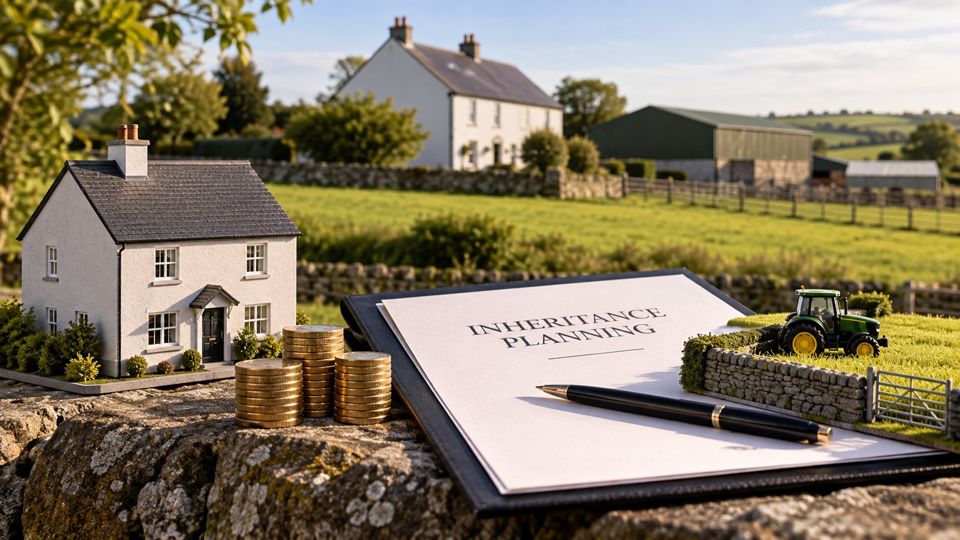
Owning a house is completely normal. But when it comes to inheriting a farm, it can have consequences that many families never think about until succession planning begins.
For many farm families, Agricultural Relief is one of the most important reliefs available when a farm passes from one generation to the next.
But qualifying for it is not simply a question of:
“Am I inheriting a farm?”
The financial position of the person receiving the farm matters too.
And one of the things that can have a surprisingly significant impact is already owning a house.
Why does owning a house matter?
One of the requirements for Agricultural Relief is commonly known as the 80% agricultural asset test.
Broadly, at least 80% of the beneficiary’s relevant property must consist of agricultural property at the relevant valuation date.
That means the farm being received is not looked at completely in isolation.
The wider asset position of the person receiving it can matter as well.
This is where an ordinary house can become important.
A house can work against the 80% test
If you already own a house that does not qualify as agricultural property, its value can sit on the non-agricultural side of the calculation.
The higher the value of your non-agricultural assets, the more difficult it may become to satisfy the 80% test.
For example, someone may be due to inherit a substantial farm but already own a valuable house.
They may assume that because the farm is worth considerably more than the house, Agricultural Relief will automatically apply.
That is not necessarily the case.
Other assets can matter too, and the position needs to be looked at as a whole.
What about the mortgage on the house?
This is an area where people need to be particularly careful.
Do not assume that simply because a property has a mortgage, the outstanding mortgage can automatically be deducted for the 80% Agricultural Relief asset test.
That is not how the rule works.
There are specific circumstances where certain borrowings connected with a principal private residence may be relevant to the asset test.
But whether a loan can be taken into account depends on the nature of the property, the borrowing itself and what the money was actually used for.
That is very different from saying:
“My house is worth €300,000 and I owe €200,000, so only €100,000 counts.”
You should not make that assumption.
The treatment of a mortgage, refinance, equity release, investment loan or other borrowing may differ depending on the circumstances.
The exact facts matter.
So if you own a property with debt attached to it, the question is not simply:
“How much is left on the mortgage?”
The more important question is:
“Can this particular borrowing actually be taken into account for the Agricultural Relief asset test?”
That needs to be established before relying on it.
What if the house is a farmhouse?
This is another area where assumptions can cause problems.
A dwelling house can, in certain circumstances, form part of agricultural property for Agricultural Relief purposes.
But a house does not automatically become a qualifying farmhouse simply because:
it is owned by a farmer
a farmer lives in it
the person living there farms the surrounding land
it is located in the countryside
or even because the house is physically situated on the farm
Being on the farm is not enough on its own.
The relationship between the dwelling, the agricultural land and the farming activity needs to be considered.
So a house that a family has always referred to as “the farmhouse” does not automatically qualify as agricultural property for Agricultural Relief purposes.
For succession planning purposes, “farmhouse” is not simply a description or a label — the property has to actually qualify.
That can become particularly important where:
the house and land are in different ownership
the dwelling has previously been transferred separately from the farmland
rights of residence or occupation exist
only a small amount of land is associated with the dwelling
the house is occupied by someone other than the person farming the land
or the relationship between the house and the farming operation has changed over time
Before treating a house as agricultural property in an 80% calculation, its status needs to be properly established.
Two dangerous assumptions to avoid
When looking at Agricultural Relief, never simply assume:
“There is a mortgage on the house, so I can deduct it.”
or
“The house is on the farm, so it qualifies as a farmhouse.”
Both assumptions may be wrong.
And if either assumption is wrong, the resulting 80% calculation may also be wrong.
Why this catches families out
Most people do not buy their home while thinking about the Agricultural Relief rules that may apply 10, 20 or 30 years later.
They buy a house.
They pay a mortgage.
They build up savings.
They may acquire other assets.
Meanwhile, Mam and Dad continue to own the farm.
Eventually, the family begins talking seriously about succession and assumes the main question is:
“Who is getting the farm?”
But that is only part of the picture.
The position of the person receiving it can be just as important.
Two successors can receive the same farm and have very different outcomes
This is one of the most important things to understand.
Two people could potentially receive farms of exactly the same value and have very different Agricultural Relief positions.
One may own relatively few non-agricultural assets.
The other may own a house, savings, investments or other property.
One house may potentially qualify as agricultural property.
Another may not.
One borrowing may be relevant to the asset test.
Another may not be.
The value of the farm alone does not tell you the answer.
This is why succession planning needs to happen before the transfer
The worst time to discover an Agricultural Relief problem is when the farm is already about to be transferred.
Good succession planning should identify these issues early.
That means looking at more than the parents’ farm.
It can mean looking at:
what the successor already owns
the value and nature of their house
whether a dwelling could potentially qualify as agricultural property
mortgages and other borrowings
other assets
the ownership structure
the timing of the proposed transfer
and how the wider succession plan fits together
It is the interaction between these things that matters.
The key question
If you own a house and expect to receive a farm, the question is not simply:
“Will my house stop me getting Agricultural Relief?”
The better question is:
“What will my overall asset position look like when the farm is transferred?”
That is where the answer becomes specific to the individual.
And it is one of the reasons succession planning should begin long before anyone signs a transfer document.
Want clarity on your own position?
Every farm family is different.
During a Farm Succession Planning Session, we look at the wider picture around the proposed succession — including the people involved, the assets being transferred, the successor’s position and the issues that may need further tax or legal advice before anything happens.
If you want to understand where you currently stand, what potential issues may exist and what questions need to be answered next:
Join the Farm Succession Planning Session Waiting List Below
Sessions are released in limited numbers.