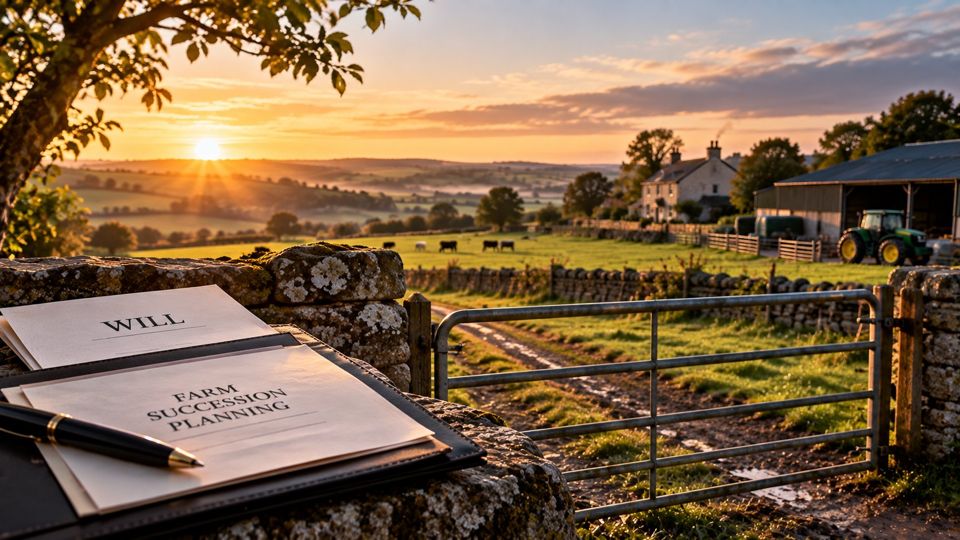
A practical look at what can happen when a farm succession plan has been discussed or started, but never fully put in place.
Many farming families have a succession plan in their heads.
Everyone may know who is expected to take over the farm.
There may have been conversations around the kitchen table.
The accountant may have been spoken to.
A solicitor may even have been contacted.
But there can be a very big difference between:
what the family intends to happen
and
what has actually been put in place.
If a farmer dies before the succession process is completed, that difference can suddenly become extremely important.
Once someone dies, intentions are not enough
This is probably the most important point.
If a farmer dies unexpectedly, the estate has to be dealt with according to the legal arrangements that actually exist at that point.
That can include:
the terms of a valid will
the ownership of the assets
succession law
the rights of a surviving spouse or civil partner
and the wider circumstances of the estate
A conversation, promise or intended future transfer does not automatically determine what happens.
In Ireland, succession is governed principally by the Succession Act 1965. If there is no valid will, the estate is distributed under the statutory rules of intestacy rather than according to what the deceased may have informally intended.
That is why the difference between “we have a plan” and “the plan is implemented” matters so much.
The farm may not pass in the way everyone expected
A family may have understood for years that one son or daughter would eventually receive the farm.
They may already be farming it.
They may have invested time, labour and money into it.
Mam and Dad may have made their intentions perfectly clear.
But if those intentions have not been properly reflected in the arrangements that exist at the time of death, the eventual outcome may be different.
A valid will can be hugely important, but even a will exists within the wider framework of succession law.
For example, a surviving spouse or civil partner can have a legal right share in an estate regardless of what a will says, subject to the particular circumstances.
So succession planning is not simply about deciding who should receive the farm.
It is about making sure the legal and financial structure actually supports that intended outcome.
What if there is no will?
If someone dies without a valid will, they die intestate.
In that situation, the estate is distributed according to succession law.
The legislation determines who is entitled to the estate depending on which relatives survive the deceased.
That may or may not produce the outcome the farmer had intended.
This can become particularly significant with a farm because agricultural property is not always an easily divisible asset.
A farm may include:
agricultural land
the farmhouse
sheds and farm buildings
livestock
machinery
forestry
entitlements
cash
investments
and other property
Once several people potentially have interests in an estate, achieving the outcome everyone thought was going to happen can become considerably more complicated.
Delays can become a real problem
When someone dies, the family is already dealing with bereavement.
Adding uncertainty around the farm can make an extremely difficult period even harder.
Questions can arise very quickly.
Who is entitled to make decisions?
Who can operate the farm?
What happens to livestock?
Can land be leased?
Can machinery be sold or replaced?
Who pays ongoing bills?
What happens to existing borrowings?
Can a major decision about the farm proceed?
Some of these issues can ultimately be resolved through the administration of the estate, but that process can take time.
Meanwhile, the farm is still a working business.
Cattle still have to be fed.
Bills still arrive.
Land still has to be managed.
The tax position may also be different
This is another major reason why an unfinished succession plan can matter.
The tax position following an inheritance may not be the same as the position that would have arisen under a planned lifetime transfer.
Different reliefs have different conditions, and those conditions have to be satisfied at the relevant time.
For example, Agricultural Relief can reduce the taxable value of qualifying agricultural property by 90%, but it is subject to specific conditions.
One of those conditions is the 80% agricultural asset test.
Revenue states that the beneficiary must satisfy that test on the relevant valuation date.
That means the beneficiary's circumstances at that point can become extremely important.
A person who was expected to receive the farm several years later may suddenly inherit it much earlier than anticipated.
Their asset position may be different.
Their employment situation may be different.
The structure of the farm may be different.
And planning that might otherwise have taken place before the transfer may never have been completed.
Starting a succession plan is not the same as completing one
Starting the conversation is important.
It is often the hardest part.
But a succession plan does not become effective merely because everybody understands what Mam or Dad wants to happen.
There may still be a series of steps required involving:
legal documentation
wills
ownership
valuations
tax analysis
family decisions
borrowing
business structures
and the eventual transfer itself
Some families spend years discussing succession while never quite reaching the implementation stage.
That can create a false sense of security.
Everyone thinks:
“We have it sorted.”
When what they really mean is:
“We know what we would like to happen.”
Those are not the same thing.
Family tension can appear very quickly
Where the position is unclear, even families with good relationships can come under pressure.
It does not necessarily mean anyone is being difficult.
Different people may simply have different understandings of what was promised.
One person may remember being told they would receive the farm.
Another may believe the farm was supposed to be shared.
Someone else may have expected to receive another asset instead.
And once the person who was supposed to clarify those intentions is no longer there, those disagreements can become much harder to resolve.
The clearer the arrangements are before death, the less room there is for uncertainty afterwards.
A will is important — but succession planning is bigger than a will
One mistake I regularly see is people treating succession planning and making a will as though they are the same thing.
They are not.
A will is an extremely important part of the process.
But succession planning can also involve questions around:
how the farm is currently owned
whether assets are held jointly or individually
who is expected to farm into the future
the successor's own financial position
tax reliefs
the farmhouse
non-farming children
debts and borrowing
business structures
timing
and how the parents will be financially supported after a transfer
A will answers an important question:
What happens if I die?
A succession plan should also address:
What are we actually trying to achieve, and what needs to happen to get there?
The most dangerous words can be “we'll finish it later”
Farm succession rarely feels urgent when everybody is healthy.
There is another year.
Another winter.
Another tax return.
Another conversation with the solicitor.
And that is exactly why plans can remain half-finished for years.
Nobody expects a death, illness or sudden change in circumstances to happen before the process is completed.
But succession planning is partly about removing that dependency on perfect timing.
The key point
A partially completed succession plan is not the same as a completed one.
If something happens before the process is finished, the estate will have to be dealt with based on the legal and financial position that actually exists at that time.
Not simply on what everyone intended to do later.
That can affect:
who receives the farm
when they receive it
the administration of the estate
the tax position
the operation of the farm
and the wider family
If your family has “started” the succession conversation
Ask yourself one simple question:
If something happened tomorrow, would the outcome actually be the one we are expecting?
If the answer is unclear, there is probably still work to do.
Want clarity on where your succession plan currently stands?
Every family is different.
During a Farm Succession Planning Session, we look at the current position, what the family is trying to achieve, what has already been put in place and what areas still need to be addressed.
The purpose is not simply to talk about succession.
It is to establish where you are now and what needs to happen next.
Join the Farm Succession Planning Session Waiting List Below
Sessions are released in limited numbers.